![janes.jpg]](https://i.janes.com/hs-fs/hubfs/janes.jpg?height=40&name=janes.jpg)
These systems operate without a human being positioned on or within the vehicle, and their operation is achieved through autonomous or remote control. Unmanned Sea Vehicle feeds to the Unmanned Systems blended market.
This document contains definitions for the market, customer missions, and unique market attributes.
The Unmanned Sea Vehicle Market includes:
- Surface and underwater vessels used for counter-mine detonation, mine warfare, intel- ops, inspection, surveillance and protection, route mapping, target training, ocean survey, hull inspection, rescue, coastal patrol;
- Tethered and un-tethered variants;
- Significant system upgrades, modernization or refurbishment programs;
- Service and support focused within the Unmanned Sea Vehicle market.
The Unmanned Sea Vehicle Market does not include:
- Manned sea systems;
- One-way attack platforms such as torpedoes (contained in PGW market);
- Formerly manned platforms fitted for remote control (drones )
- Target systems not intended for re-use;
- Non-powered items such as towed sonars;
- Company-funded research and development;
- Government budget for overhead and program management.
Unmanned Sea Vehicles Customer Function
Classifying ships is not an exact science. Sizes, outfitting and designations are generally decided upon by the builder or user. Very similar vessels that one user may call frigates may be called destroyers by another user.
| Amphibious | Vessels and craft designed for transport, delivery and sustainment of troops, vehicles and equipment over the shore into the battlefield. Larger amphibious vessels typically use smaller landing craft and helicopters for ship-to-shore transport but some retain a beach landing capability. Includes large flat top amphibious assault ships capable of operating Short-Take-Off-Vertical-Landing fixed-wing aircraft if designated as amphibious assets by builder and/or operator. |
|---|---|
| Attack Sub | Typically designated SSN, attack submarines are primarily hunter-killer oriented. Modern attack submarines can attack land targets as well as sea targets. |
| Ballistic Sub | Typically designated SSBN, ballistic submarines are uniquely designed for the mission of land target strategic strike. |
| Carrier | Ocean and sea-going vessels capable of functioning as full service airfields for aircraft designed for such operations. |
| Coastal/Patrol | Non-ocean, non-sea going vessels occasionally lightly armed and used for search, rescue and border enforcement. |
| Command Ship | A ship equipped to act as a mobile, floating command center for control and co-ordination of local, regional, and/or worldwide operations. |
| Corvette | Small, lightly armed vessel, originally smaller than a frigate and larger than a coastal patrol craft; some recent designs resemble frigates in size and role. |
| Cruiser | Dreadnoughts upward of 15K tons displacement or designated as a cruiser by the builder and/or user. |
| Destroyer | Combat ships in the 5K to 15K ton displacement range and designated as a destroyer by the builder and/or user. |
| Frigate | Combat and special mission vessels typically smaller than a destroyer but designated as a Frigate by the builder and user. |
| Icebreaker | Ships with high-strength hulls and excess power capable of breaking sea ice to allow other ships to navigate regions with seasonal or permanent ice cover. May also provide logistic and scientific research support and fulfill patrol tasks in Polar Regions. |
| Intel/Surveillance | Ships equipped to collect information on adversary operations and technology by means of passive interception and analysis of communications and other electronic signals, and/or collection of acoustic intelligence in the undersea domain. May include electronic countermeasures/jamming capability. |
| Logistics/Support | Naval auxiliary ships which have the capability to support the fleet with liquids, solid stores, and spares while underway and/or alongside. |
| Mine Warfare | Small ocean and sea capable ships that typically operate in littoral or harbor water depths environments to lay and sweep mines. |
| Salvage/Rescue | Ships equipped to provide assistance to disabled vessels and/or submarines. May feature firefighting and towing capability; provide heavy lift capability from ocean depths; and support manned and submersible diving operations. |
| Sealift | Non-combatant vessels used for the transportation of military cargo to areas of operation. Typically commercial cargo and Roll-On/-Roll-Off ships taken up from trade and requiring secure port facilities for loading and off-loading. Also vessels that act as floating warehouses and can transfer cargo to amphibious warfare ships while at sea for onward delivery into the battlefield. |
| Survey/Oceanography | Vessels that are used to map the ocean floor and perform acoustical, biological, physical and geophysical surveys to provide data that aids our understanding of oceans and the undersea domain. |
| Training | Vessels used for training ships’ crew that are equipped with systems essential to provide instruction in modern seamanship, navigation and the proper and safe operation of ships’ equipment. |
| Multiple | This category includes any instance when the record involves more than one functional segmentation category. |
| Other | Miscellaneous ships that do not fit in any of the other functional segment groups. |
| Research &Technology | Includes basic/detailed design, system development, studies and general ship related technology. |
| Unidentified R&D | A modeled estimate of R&D Sales not yet identified. |
Unmanned Sea Vehicle Attributes
Endurance (days) is an attribute which defines the time that the unmanned sea vehicle can operate under its own power.
- 0-0.1
- 0.11-0.50
- 0.51-1.0
- 1.01-5.0
- 5.01-15
- 15.01-30
- 30.01-60
- 60+
Size Classification
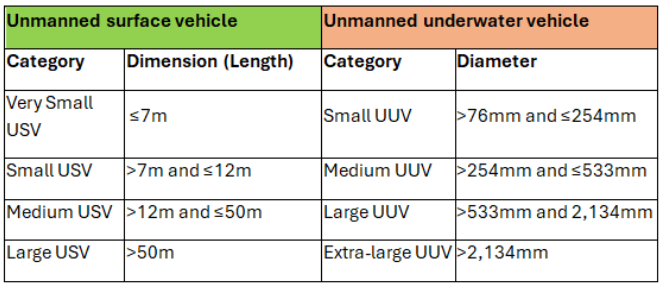
Size classification is an attribute which defines the length of an unmanned surface vehicle, or the diameter of unmanned underwater vehicle, in categories ranging from very small to Extra-large, based on the following US Navy standard:
Additional attributes include:
- Remotely operated vehicle (ROV)
- N/A