![janes.jpg]](https://i.janes.com/hs-fs/hubfs/janes.jpg?height=40&name=janes.jpg)
Janes views a country’s overall military capability as the dynamic relationship between a country’s military doctrine, organisation and training of its armed forces, military infrastructure, and defence equipment that shapes a country’s ability to respond to internal and external security threats.
Janes Military Capability Assessment Matrix focuses on the assessment of seven capability categories; direct ground combat, fire support, intelligence, surveillance, and reconnaissance (ISR), air defence, anti-surface warfare, anti-submarine warfare, and logistics. Each one of the seven capability categories is further divided into three sub-categories focusing on the land, air, and maritime domains.
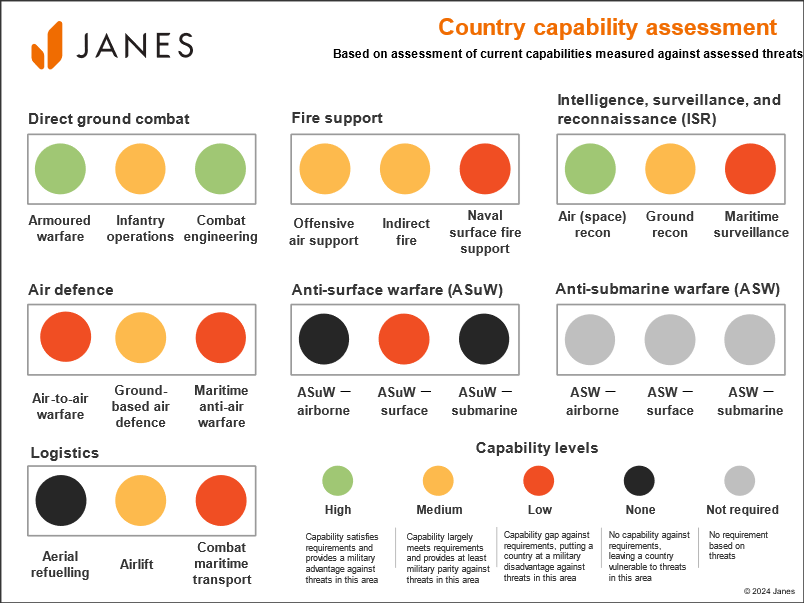
Janes has developed a set of approximately 220 primary and secondary questions corresponding to each of the 21 capability sub-categories. The methodology was developed by a cross-functional team of Janes subject-matter experts (SMEs). The 21 capability level assessments are specific to each country and do not function as a country comparison tool. Janes Military Capability Assessment Matrices are audited annually.
The methodology is applied through a multi-layered analytical approach utilising Janes open-source defence intelligence. Janes Country Intelligence SMEs provide a qualitative assessment of each country’s military doctrine, strategy, and threat environment that informs the respective capability requirement. This qualitative assessment is then combined with Janes assured and interconnected defence inventory data and defence equipment profiles, allowing for an in-depth assessment of each capability. Each capability sub-category is assessed based on a 5-level scale ranging from ‘Not required’ to ‘High’. Janes defines these capability levels as:
|
Capability level |
Definition |
|
High |
Capability satisfies requirements and provides a military advantage against threats in this area |
|
Medium |
Capability largely meets requirements and provides at least military parity against threats in this area |
|
Low |
Capability gap against requirements, putting a country at a military disadvantage against threats in this area |
|
None |
No capability against requirements, leaving a country vulnerable to threats in this area |
|
Not required |
No requirement based on threats |